

- 13-18 Min Read
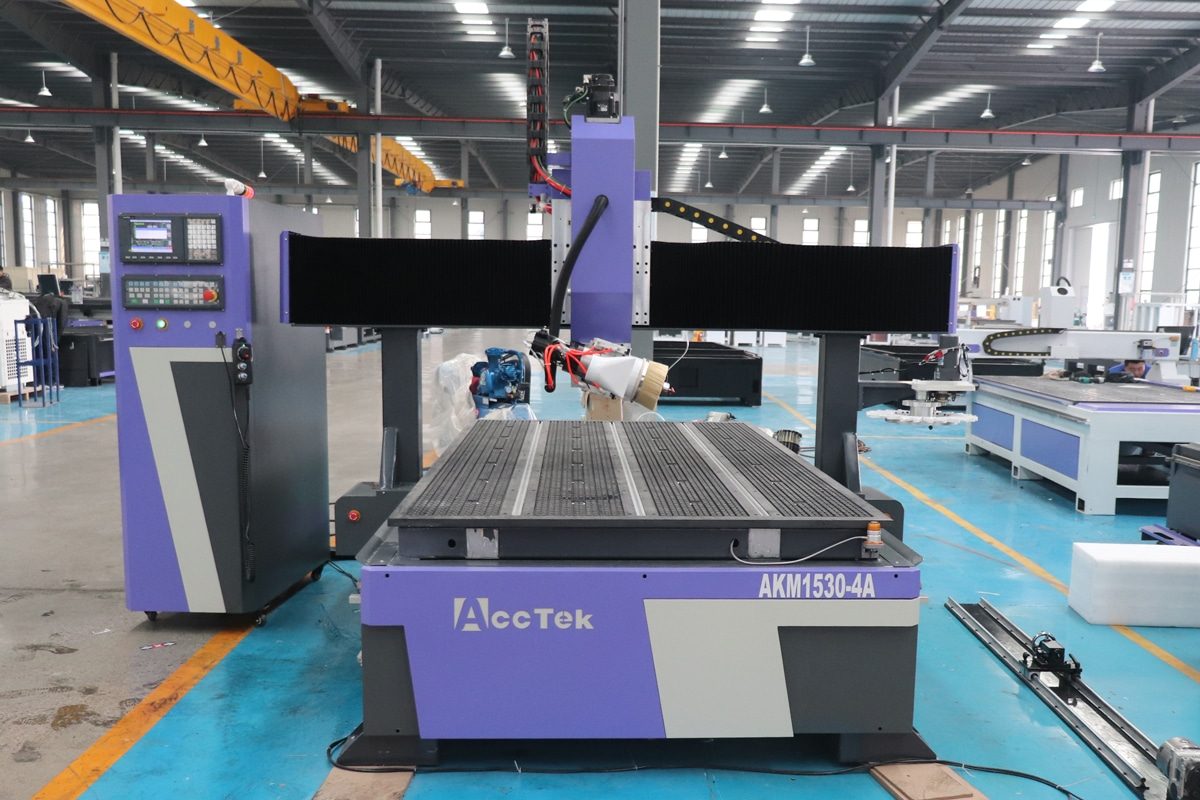
As manufacturing moves toward greater precision and customization, CNC routers are expected to handle increasingly complex designs and multi-angle machining tasks. Traditional 3-axis CNC routers are reliable for standard cutting and engraving tasks, but they often struggle with multi-angle machining, inclined surfaces, and complex 3D geometries that require multiple setups. To overcome these limitations, many workshops and industrial manufacturers are turning their attention to swing-head 4-axis CNC routers.
A swing-head 4-axis CNC router enhances machining flexibility by allowing the spindle to tilt and approach the workpiece from various angles without requiring repositioning. However, investing in this advanced technology requires careful evaluation. Is a swing-head 4-axis CNC router truly the right choice for your business? In this article, we’ll explain what a swing-head 4-axis CNC router is, how it works, its key advantages and applications, and the critical factors you should evaluate to determine whether it’s the right investment for your business.
Understanding the 4-Axis CNC Router with Swing Head
A 4-axis CNC router is a sophisticated tool that extends the capabilities of traditional 3-axis CNC routers by adding an axis of movement, typically referred to as the fourth axis. This added functionality makes it possible to perform more complex operations on workpieces, allowing for greater precision and the ability to create intricate shapes, contours, and designs. But what sets a 4-axis CNC router with a swing head apart is the unique ability of the router head to rotate, further enhancing the machine’s versatility. Let’s dive deeper into the key features and functions that make these machines so powerful.
Key Features and Components
- The 3 Main Axes: Like any traditional CNC router, a 4-axis machine operates along the standard X, Y, and Z axes, which control movement in three-dimensional space—left to right (X), forward and backward (Y), and up and down (Z). These axes are the foundation for most cutting, milling, and engraving processes.
- The Fourth Axis (A-axis): The addition of a fourth axis enables rotational movement around the X or Y axis. This allows the CNC router to approach a workpiece from multiple angles without requiring repositioning or re-fixturing, which is particularly useful for complex parts.
- The Swing Head: A swing head refers to a rotating spindle or router head that can pivot or tilt at different angles, usually in the X-Y plane. This rotational capability provides the machine with additional flexibility, enabling it to work on complex parts with complex geometries.
How the Swing Head Works
The swing head on a 4-axis CNC router adds an extra dimension to traditional 3-axis machining. It allows for angular rotation, which means the cutting tool can be positioned at any angle relative to the workpiece, providing greater flexibility and accuracy. Here’s how it works:
- Rotational Movement: The swing head can rotate along the fourth axis (usually the A-axis), allowing it to access multiple sides of the workpiece without having to reposition or reset the part. This rotational movement enables complex cuts and detailed carving that a standard 3-axis CNC router would struggle with.
- Dynamic Machining: As the machine rotates the swing head, it can move in tandem with the three main axes. This dynamic capability means you can cut, mill, and engrave intricate designs and contours that would be impossible with a fixed, stationary spindle.
Common Applications of the 4-Axis CNC Router with Swing Head
- Engraving and Milling: The swing head allows for multi-angle engraving, making it perfect for detailed signage, artwork, or customized designs where precision at varying angles is crucial.
- 3D Carving: The ability to rotate the tool on the fourth axis opens up possibilities for creating 3D carvings in a wide range of materials, including wood, stone, and plastic. This makes the swing head invaluable in artistic projects, custom woodworking, and sculpture.
- Model Making: A 4-axis CNC router is a tool for the efficient manufacture of both ship hull models and car models. The combination of four axes of movement, along with the added functionality of a swing head, allows for multi-dimensional cutting and carving.
Understanding the mechanics of the 4-axis CNC router with a swing head reveals just how much more versatile and capable it is compared to standard routers. By adding rotational movement and tool flexibility, this system enables operators to create more intricate, multi-dimensional designs with greater ease and precision. Whether you’re engaged in detailed engraving, 3D carving, or complex part fabrication, the swing head’s ability to access workpieces from multiple angles and reduce the need for part repositioning offers significant improvements in both efficiency and accuracy. With this foundational knowledge, operators can unlock the true potential of the 4-axis CNC router, paving the way for a wide array of advanced machining possibilities.
Key Advantages of a 4-Axis CNC Router
A 4-axis CNC router offers manufacturers a powerful combination of precision, flexibility, and efficiency for tackling complex machining tasks. With its tilting spindle, the machine can easily reach angled surfaces, carve intricate 3D designs, and handle multi-surface components in a single setup. Knowing the benefits of a 4-axis CNC router makes it easier to see why this machine is the right choice.
- Greater Machining Flexibility: The tilting spindle allows the tool to approach the workpiece from multiple angles, making it possible to machine inclined surfaces, bevels, and complex 3D shapes without repositioning the material. This flexibility significantly expands the range of parts that can be produced.
- Reduced Setup Time: Because multi-angle features can be machined in a single setup, there is far less need for manual repositioning or refixturing. This not only saves time but also reduces the risk of alignment errors between operations.
- Improved Accuracy and Consistency: Maintaining a fixed workpiece while changing tool angles improves dimensional accuracy. The machine can keep a consistent cutting orientation, resulting in better surface finishes and more reliable repeatability, especially for complex geometries.
- Higher Production Efficiency: Fewer setups, shorter machining cycles, and smoother toolpaths contribute to faster overall production. This makes 4-axis CNC routers well-suited for both custom work and medium-to-high volume manufacturing.
- Enhanced Surface Quality: By optimizing tool angles during cutting, the machine reduces tool marks and uneven finishes. This is particularly beneficial for curved surfaces, molds, artistic carvings, and decorative components.
- Cost-Effective Alternative to 5-Axis Machines: For many applications, a 4-axis CNC router delivers much of the flexibility of a 5-axis machine at a lower investment cost and with simpler operation and programming requirements.
- Expanded Application Capabilities: For 2D operations, it handles standard cutting, engraving, and profiling with the same precision as a conventional 3-axis CNC. When it comes to 3D tasks, the tilting spindle allows the machine to tackle complex surfaces, curved contours, and angled features that would be difficult or impossible to achieve with a fixed spindle.
The 4-axis CNC routers provide a range of benefits that make them a valuable addition to any workshop or manufacturing facility. Their ability to perform multi-surface and inclined surface machining in a single setup, coupled with improved accuracy, faster production, and broader application capabilities, allows businesses to take on more complex projects with confidence. By leveraging these advantages, manufacturers can enhance workflow efficiency, reduce operational errors, and expand their range of production possibilities, making swing-head 4-axis CNC routers a smart investment for companies seeking both precision and versatility.
Swing-Head 4-Axis vs. Traditional 3-Axis CNC Routers
When evaluating CNC routers, it is necessary to understand their machining capabilities to determine which machine can best handle your production needs. The addition of a tilting spindle in a swing-head 4-axis CNC router significantly expands the types of parts and geometries that can be machined compared to a traditional 3-axis machine.
Machining Capability Comparison
- 4-Axis CNC Router: Features a tilting spindle that adds a rotational axis, enabling the tool to reach angled surfaces, bevels, undercuts, and complex 3D contours in a single setup. Multi-surface machining is possible without repositioning the workpiece, which improves accuracy and surface quality.
- 3-Axis CNC Routers: Move the tool along X, Y, and Z axes only. They are well-suited for flat surfaces and simple curves, but angled or multi-surface features require multiple setups or manual repositioning, which increases the chance of errors and reduces efficiency.
Productivity and Flexibility Differences
- 4-Axis CNC Router: Can complete multi-angle and multi-surface operations in one setup, reducing production time and minimizing human intervention. Its ability to handle complex parts and varied geometries makes it highly flexible for different manufacturing tasks.
- 3-Axis CNC Routers: Require multiple setups for complex geometries, which increases production time and limits workflow flexibility. Best suited for straightforward, flat, or slightly curved parts, with less adaptability for varied or intricate designs.
Cost and Learning Curve Considerations
- 4-Axis CNC Router: Generally involves a higher upfront cost due to the additional spindle mechanism and control system. Programming is more complex, as toolpaths must coordinate linear movements with spindle tilting, requiring advanced CAM software and trained operators. However, efficiency gains and precision often justify the investment for complex production.
- 3-Axis CNC Routers: More affordable and easier to operate, with simpler programming and lower training requirements. While upfront costs are lower, handling multi-angle or complex parts may increase labor time and reduce overall productivity.
In terms of machining capability, 4-axis CNC routers clearly outperform traditional 3-axis machines for tasks involving angled surfaces, 3D contours, and multi-surface features. While 3-axis CNC routers are reliable for flat or simple curved parts, the additional rotational axis in a 4-axis machine allows for greater precision, fewer setups, and more efficient handling of complex components. Understanding these differences is key to selecting a CNC router that meets both your production demands and quality expectations.
Swing-Head 4-Axis vs. Rotary 4-Axis CNC Routers
When it comes to advanced 4-axis CNC machining, businesses often face a choice between swing-head and rotary configurations. Both expand capabilities beyond a standard 3-axis CNC router, but they achieve multi-axis movement in different ways. Swing-head machines tilt the spindle to reach angled surfaces, while rotary machines rotate the workpiece itself. Understanding the differences in how these machines operate, the types of parts they are best suited for, and their programming and accuracy considerations helps select the right solution for your production needs.
Spindle Rotation vs. Workpiece Rotation
- Swing-Head 4-Axis: The additional axis is in the spindle, which tilts to reach different angles while the workpiece remains stationary. This allows the cutting tool to access complex surfaces and angled features without repositioning the material.
- Rotary 4-Axis: The additional axis is on the worktable, causing the workpiece itself to rotate. The spindle maintains its standard orientation while the part turns, making it ideal for cylindrical or symmetrical components.
Ideal Workpiece Shapes for Each Configuration
- Swing-Head 4-Axis: Best suited for angled surfaces, multi-plane parts, complex 3D contours, and asymmetric designs. Examples include furniture components with bevels, architectural carvings, molds, and intricate signage.
- Rotary 4-Axis: Excels with cylindrical or symmetrical parts such as table legs, chair spindles, balusters, pipes, and round signage. Continuous rotation allows for smooth 360° machining around the part.
Accuracy and Programming Complexity
- Swing-Head 4-Axis: Maintains the workpiece stationary, reducing alignment and fixture errors. Toolpaths must account for coordinated linear and rotational movement, which increases programming complexity and may require more advanced CAM software and operator expertise.
- Rotary 4-Axis: Accuracy depends on the precise rotation of the workpiece, requiring the fixture to maintain sufficient stability. Programming focuses on indexing or continuous rotation, which is generally simpler than swing-head multi-angle toolpaths but still requires careful setup for consistent results.
Choosing between a swing-head and a rotary 4-axis CNC router depends largely on the geometry of the parts you produce and your workflow requirements. Swing-head CNC routers excel at complex, multi-angle, and asymmetric parts, allowing the spindle to tilt and machine intricate surfaces without repositioning the workpiece. Rotary 4-axis CNC routers are ideal for cylindrical or symmetrical components, offering smooth rotational machining around the workpiece. By evaluating the advantages and limitations of each configuration, manufacturers can select the machine that maximizes precision, efficiency, and overall productivity for their specific applications.
Key Factors to Consider Before Investing
Investing in a 4-axis CNC router is a significant decision that can greatly impact your production efficiency, capabilities, and long-term growth. While the machine offers advanced multi-angle machining and expanded application potential, its benefits are best realized when it aligns closely with your operational needs and resources. Before making a purchase, it’s essential to evaluate several key factors that influence performance, usability, and return on investment. These considerations help maximize return on investment and avoid operational challenges.
Production Requirements
When considering a 4-axis CNC router, the first factor to evaluate is your production requirements. This involves understanding the types of parts, materials, and volume your business typically handles.
- Part Complexity: Determine whether your production involves angled surfaces, multi-plane features, or intricate 3D contours. 4-Axis CNC routers excel at handling complex geometries that are difficult or time-consuming with simpler machines.
- Production Volume: Assess whether your workflow requires frequent machining of complex parts or occasional multi-angle operations. High-complexity, moderate-to-high-volume production can justify the investment in a 4-axis machine.
- Material Range: Consider the types of materials you process, such as wood, plastics, composites, or non-ferrous metals. Ensure the machine’s spindle power, speed, and tooling capabilities match your material requirements.
Budget and Return on Investment (ROI)
Careful consideration of budget and ROI ensures that your investment in a swing-head 4-axis CNC router aligns with both financial goals and production requirements.
- Initial Investment: 4-Axis CNC routers typically have a higher upfront cost compared to traditional 3-axis machines, due to the advanced spindle mechanism, additional rotational axis, and more sophisticated control systems. Additional expenses may include installation, tooling, software, and operator training.
- Efficiency Gains: Despite the higher initial cost, a 4-axis CNC router can significantly reduce setup time, minimize secondary operations, and increase production throughput. Performing complex, multi-angle machining in a single setup saves labor and shortens production cycles.
- Quality and Waste Reduction: Improved precision and consistency help reduce material waste and rework, lowering operational costs over time.
Software and Programming Compatibility
Carefully assessing software and programming compatibility ensures smooth implementation, reduces errors, and helps you maximize the performance and productivity of a swing-head 4-axis CNC router.
- CAD/CAM Software Support: Ensure your CAD/CAM software supports 4-axis toolpaths and can generate accurate post-processed code for the machine.
- Post-Processor Availability: A compatible and well-optimized post-processor is required to translate toolpaths correctly for the machine controller.
- Programming Complexity: Compared to standard machining, 4-axis programming involves managing spindle orientation, tool angle, and synchronized axis movement, which adds complexity to toolpath creation and verification.
Operator Skill and Training
A swing-head 4-axis CNC router offers advanced capabilities, but realizing its full potential depends heavily on the skill level of the operators and the quality of training provided.
- Required Skill Level: Operating a 4-axis machine requires a solid understanding of CNC fundamentals, as well as familiarity with multi-axis movement, tool orientation, and machine kinematics.
- Programming Knowledge: Operators may need to interpret or adjust 4-axis toolpaths, understand spindle tilting angles, and recognize potential collision risks during machining.
- Training Investment: Proper training reduces the risk of programming mistakes, tool crashes, and machine downtime, especially when multiple axes move simultaneously.
Space and Infrastructure Requirements
Before investing in a swing-head 4-axis CNC router, it’s important to ensure your facility can support the machine’s physical and operational needs.
- Machine Footprint: 4-Axis CNC routers often require more floor space than standard machines due to their larger structure, tool movement range, and safety clearances. Verify that your workshop layout can accommodate the machine comfortably.
- Power Supply: Check that your electrical system meets the machine’s voltage, phase, and power capacity requirements. Upgrades may be necessary for high-power spindles or industrial controllers.
- Dust Extraction and Ventilation: Effective dust collection and ventilation systems to maintain a safe and clean working environment, especially when machining wood, composites, or plastics.
Carefully assessing these key factors ensures that your investment delivers real value. A 4-axis CNC router can significantly enhance productivity, precision, and flexibility, but only when it is properly matched to your business goals and infrastructure. By taking a strategic approach to evaluation, you can minimize risks, optimize performance, and maximize the long-term benefits of your CNC equipment investment.
When a Swing-Head 4-Axis CNC Router Is the Right Choice
A 4-axis CNC router is the right choice when your business needs greater machining flexibility, higher efficiency, and the ability to handle complex geometries that go beyond standard machining requirements. Below are the key situations where investing in this type of machine makes the most sense.
- You Regularly Machine Complex or Angled Parts: If your products include inclined surfaces, beveled edges, undercuts, or complex 3D contours, a 4-axis CNC router allows these features to be machined accurately in a single setup. The tilting spindle ensures optimal tool angles, resulting in better surface finish and dimensional consistency.
- You want to Reduce Setup Time and Manual Repositioning: Frequent part repositioning slows production and increases the risk of alignment errors. A 4-axis CNC router minimizes secondary setups by allowing multi-surface machining without moving the workpiece, significantly improving productivity and repeatability.
- Your Business Focuses on Custom or High-Mix Production: For shops producing customized components, prototypes, or short production runs, flexibility is critical. A 4-axis router can adapt quickly to different part geometries and designs, making it ideal for high-mix, low-to-medium volume manufacturing.
- You work with 3D Designs and Artistic Components: Industries such as furniture manufacturing, architectural decoration, sign-making, mold making, and artistic carving often require smooth 3D surfaces and precise angled features. The swing-head design enables better control over tool orientation, producing higher-quality finishes on complex shapes.
- You Aim to Improve Overall Production Efficiency and Quality: By reducing setup time, minimizing errors, and maintaining consistent cutting angles, a 4-axis CNC router helps improve throughput, surface quality, and dimensional accuracy. Over time, these improvements can lead to lower labor costs and reduced material waste.
- You Are Planning for Future Growth: If your business plans include expanding into more complex products or higher-value machining work, a 4-axis CNC router provides a future-ready platform. It bridges the gap between standard CNC routing and full 5-axis machining, offering advanced capability without excessive complexity.
A 4-axis CNC router is the right choice when your business demands greater flexibility, precision, and efficiency for complex and multi-angle machining tasks. For manufacturers handling frequent design changes or aiming to reduce setup time while improving quality, this machine offers clear advantages. By aligning its capabilities with your production needs and long-term growth plans, you can ensure that a 4-axis CNC router becomes a valuable asset that strengthens both your workflow and competitive position.
When a Swing-Head 4-Axis CNC Router May Not Be Necessary
While 4-axis CNC routers offer advanced capabilities and enhanced flexibility, they are not always the right choice for every manufacturing operation. For businesses with simpler production needs, limited budgets, or minimal multi-angle machining requirements, the benefits of a 4-axis machine may not justify the investment. Below are the situations where a swing-head 4-axis CNC router may not be necessary.
- Your Work Primarily Involves Simple, Flat Machining: If most of your parts are 2D profiles, flat panels, or shallow pockets machined on a single plane, the added flexibility of a 4-axis machine may go unused. In such cases, standard machining processes can already meet accuracy and productivity requirements.
- Production Is Highly Repetitive and Standardized: For operations focused on high-volume, repetitive production of simple components, the advantages of multi-axis flexibility are often limited. Once a basic setup is optimized, additional axis movement provides little improvement in cycle time or part quality.
- Budget Constraints Are a Major Concern: 4-Axis CNC routers typically involve higher upfront costs, as well as increased expenses for software, tooling, and training. If your current workload does not justify these costs, the return on investment may be lower than expected.
- No Immediate Need for Complex 3D or Angled Features: If your current and near-future product designs do not include inclined surfaces, complex 3D contours, or multi-face machining, investing in a 4-axis CNC router may be premature.
A 4-axis CNC router may not be necessary for operations that focus on simple, flat, or repetitive parts, have budget constraints, or lack the required programming and operational expertise. By carefully assessing your production complexity, current workflows, and infrastructure readiness, you can avoid investing in capabilities that will remain underutilized. Choosing the right machine for your actual needs ensures efficiency, cost-effectiveness, and long-term operational success.
Summarize
Choosing the right CNC router is a strategic decision that should align with your business’s long-term goals, production needs, and growth plans. A swing-head 4-axis CNC router offers exceptional flexibility, precision, and efficiency for complex, multi-angle parts, making it a powerful tool for manufacturers looking to expand capabilities and improve workflow. By carefully evaluating your options, you can invest in a CNC solution that not only meets current demands but also supports your business growth and long-term success. Continue reading “A Beginner’s Guide to 4-Axis CNC Routers with Swing Head” to fully unlock the potential of your machine.
If you’re looking for reliable CNC solutions, AccTek CNC is a professional manufacturer worth considering. We offer a wide range of CNC routers—including 3‑axis, 4‑axis, 5‑axis, and rotary axis machines—designed to meet diverse machining needs from basic cutting to complex multi‑axis production. With solid build quality, versatile capabilities, and strong support, AccTek CNC provides tools that help businesses improve precision, efficiency, and overall productivity. Whether you’re upgrading your equipment or expanding into more advanced machining, AccTek CNC delivers dependable options that align with your manufacturing goals.