

- อ่าน 12-17 นาที
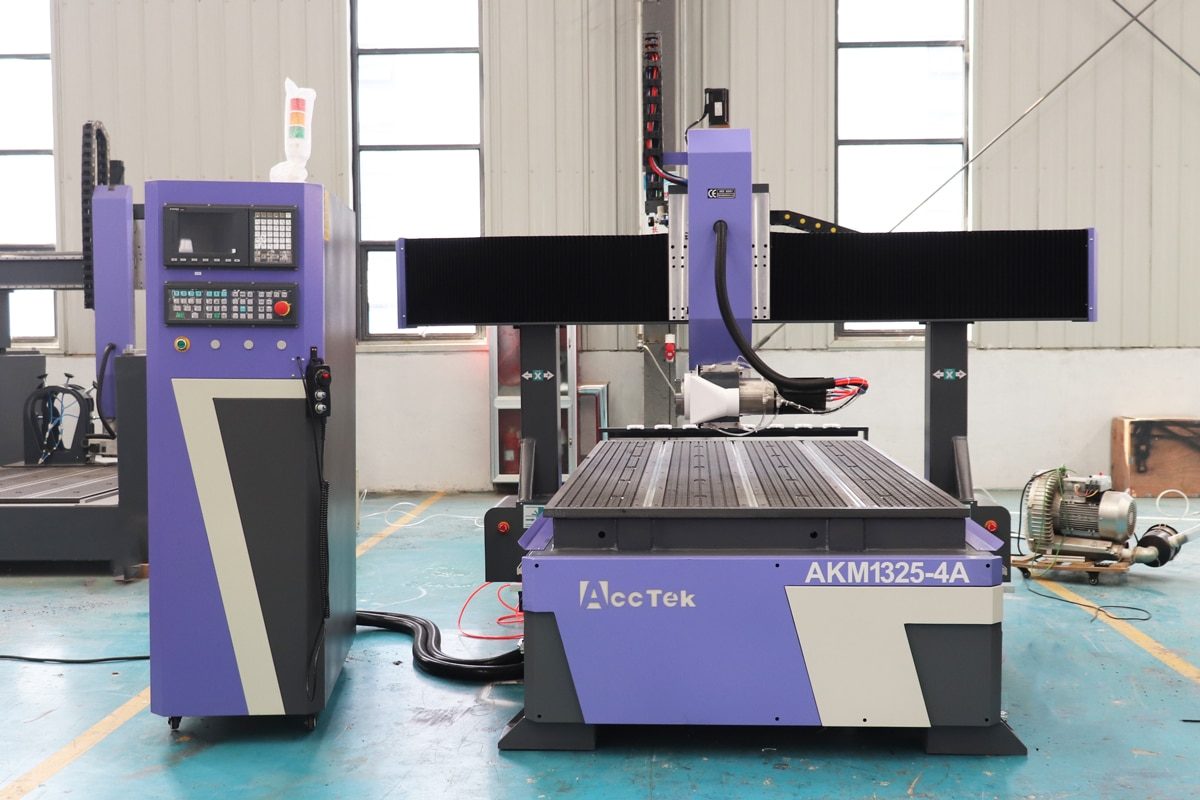
As industries increasingly demand more intricate, precise, and three-dimensional designs, traditional 3-axis CNC routers often fall short in meeting complex cutting requirements. From sculptural woodworking and decorative carvings to mold making and multi-surface machining, manufacturers are looking for solutions that offer greater flexibility without overly complicating their workflows. This is where the 4-axis CNC router with a swing head stands out.
The additional A-axis and flexible swing head mechanism enable the 4-axis CNC router to achieve more dynamic tool paths and seamless multi-faceted machining. It bridges the gap between basic 3-axis machines and more expensive, complex 5-axis systems, making it a smart and efficient choice for businesses tackling challenging geometries. In this article, we’ll explore the structure, advantages, and applications of a 4-axis CNC router and explain why it’s an ideal tool for handling complex cuts with precision and efficiency.
ทำความเข้าใจเกี่ยวกับเครื่องเราเตอร์ CNC 4 แกนแบบหัวหมุน
To fully appreciate why a เราเตอร์ CNC 4 แกน with a swing head excels at handling complex cuts, it’s important to first understand what sets it apart from other CNC machines. This type of CNC router combines rotational flexibility with a specialized swing head design that dramatically expands what’s possible in terms of precision and shape complexity.
เราเตอร์ CNC 4 แกนคืออะไร?
A 4-axis CNC router is an advanced type of computer-controlled cutting machine that adds an extra level of flexibility to traditional CNC routing. While a standard เราเตอร์ CNC 3 แกน operates along the X, Y, and Z axes, allowing the tool to move left-right, front-back, and up-down, a 4-axis machine introduces a rotational movement, typically referred to as the A-axis. This axis enables the spindle or the workpiece to tilt or rotate, allowing for angled cuts, curved surfaces, and multi-sided machining without the need to manually reposition the material. This is particularly useful for tasks such as carving complex shapes, cutting bevels, or machining parts with contours and undercuts.
ในการเปรียบเทียบ เราเตอร์ CNC 5 แกน adds yet another rotational axis (often called the B- or C-axis), giving the tool full freedom to approach the material from virtually any direction. While 5-axis machines offer the highest level of precision and versatility, they are also more expensive and complex to operate. Positioned between the simplicity of 3-axis and the complexity of 5-axis systems, the 4-axis CNC router offers an ideal balance of capability and affordability for users who need advanced cutting functions without the steep learning curve or investment of a full 5-axis machine.
What is a Swing Head?
There are two types of 4-axis CNC routers: those that use either a swing head or a rotary table to enable cutting from different angles, but the way they achieve this is very different. Rotary tables move the material, and swing heads move the tool.
A rotary table rotates the workpiece itself around a horizontal axis (usually the A-axis). This setup is ideal for cylindrical or rounded parts, such as chair legs or columns, because the machine can rotate the material while the cutting tool remains fixed. However, it often requires more complex fixturing and is less practical for large, flat, or heavy workpieces that are difficult to rotate.
In contrast, a swing head design rotates or tilts the spindle, not the material. The workpiece stays fixed on the machine bed, while the cutting head swings to various angles to perform bevels, contours, or undercuts. This approach is especially ideal when working with oversized, irregularly shaped, or heavy materials. It also simplifies setup and improves cutting consistency by reducing the need to reposition or re-clamp the workpiece. Swing heads 4-axis CNC router offers more versatility for complex flat or 3D parts, while rotary axis 4th CNC router is better suited for symmetrical, round components.
A 4-axis CNC router with a swing head bridges the gap between traditional flatbed cutting and full multi-sided machining. It enhances cutting efficiency, expands design possibilities, and simplifies complex operations by allowing the tool to tilt and rotate, rather than repositioning the material. In the discussion of the following article, the 4-axis CNC router we mentioned only refers to the 4-axis machine with a swing head.
Key Advantages of a 4-Axis CNC Router in Complex Cuts
When it comes to machining complex parts with curves, angles, and multi-sided details, a 4-axis CNC router offers several significant advantages over traditional 3-axis systems. These benefits not only improve the quality of the final product but also enhance production efficiency and reduce manual workload.
- Multi-Angle Cutting Capabilities: The added rotational axis allows the tool to approach the material from different angles, enabling bevels, chamfers, undercuts, and other intricate geometries that are impossible or inefficient with a 3-axis CNC
- Fewer Setups and Repositioning: With a 4-axis machine, parts can often be machined on multiple sides without removing and re-clamping the workpiece. This not only saves time and labor but also improves accuracy, as it eliminates the risk of misalignment between operations.
- Superior Access to Undercuts and Deep Features: Complex parts often involve features that are hard to reach with a vertically fixed spindle. A swing head allows the cutting tool to approach the workpiece from an angled position, making it easier to machine undercuts, deep cavities, and side surfaces without additional fixturing or custom tooling.
- Enhanced Surface Finish on 3D Surfaces: The ability to rotate or tilt the spindle helps maintain optimal tool orientation during cutting. This results in smoother surface finishes, especially on curved or contoured surfaces, reducing the need for secondary sanding or polishing.
- Increased Design Flexibility: With a swing head, designers are no longer limited to flat or orthogonal designs. With 4-axis capabilities, they can create more dynamic, organic, and creative geometries, opening up new possibilities in woodworking, mold-making, and artistic fabrication.
- Increased Efficiency and Productivity: By performing multiple complex operations in a single machining cycle, the 4-axis CNC router significantly reduces total production time. There’s no need for multiple fixtures or additional setups to machine different sides or angles. This streamlines the workflow and boosts overall shop efficiency, especially for batch production or customized parts.
The 4-axis CNC router stands out as a highly versatile and capable machine for complex cutting tasks. From reducing setup time to improving surface finish and enabling more creative designs, the fourth axis introduces a level of control and capability that can significantly elevate machining performance. For workshops and manufacturers looking to expand their cutting potential without the complexity of a full 5-axis system, the 4-axis machine offers the perfect balance of power, precision, and productivity.
Applications That Benefit from 4-Axis CNC Router
The 4-axis CNC router stands out as a powerful and flexible solution for manufacturers, designers, and artisans who need to produce detailed, multi-angled, and sculptural work. Its ability to tilt the cutting spindle makes it ideal for handling complex parts with minimal setup. This added flexibility translates into improved efficiency, greater design freedom, and more consistent results across a wide range of industries. Below are some of the most common and high-impact applications:
- 3D Carvings and Sculptural Work: Artists, craftsmen, and furniture makers frequently use 4-axis CNC routers for detailed 3D carvings in wood, foam, or resin. The machine’s ability to tilt the spindle enables smooth contours, deep textures, and undercuts that would be difficult to achieve with a fixed-head or 3-axis machine.
- Mold and Pattern Making: In industries like plastics, composites, and foundry casting, mold production requires precise, contoured surfaces and deep cavities. A swing head CNC router provides the tool flexibility to create accurate molds with fewer setups, ensuring consistent surface quality and dimensional accuracy.
- Complex Joinery in Furniture Manufacturing: For furniture pieces involving angled joints, curved legs, or decorative trim, the swing head spindle allows for clean bevels and tight-fitting joints all machined in one pass. This increases both efficiency and consistency in custom and mass furniture production.
- Architectural Components: Architectural millwork often includes detailed columns, corbels, arches, and decorative panels. A 4-axis CNC router simplifies the creation of these elements by providing better access to multi-surface designs and reducing the need for hand finishing.
- Signage and Dimensional Lettering: Custom signs that feature 3D letters, textured backgrounds, or multi-layered elements benefit from the ability to tilt the tool and carve at multiple depths and angles, giving the final product a more professional and dynamic appearance.
- Foam and Model Prototyping: For industries such as automotive, aerospace, or theme park design, foam models and prototypes often require smooth 3D forms and intricate shapes. A swing head CNC router enables high-speed, large-format machining with excellent surface finish, perfect for scale models and mockups.
From 3D carvings and statues to mold making and precision joinery, the 4-axis CNC router proves its value in tasks that go beyond the limits of traditional 3-axis systems. It simplifies multi-angle operations, reduces manual labor, and enhances the overall quality of complex work. The 4-axis CNC router is a versatile investment that can elevate craftsmanship and expand creative potential across industries.
How the 4-Axis Design Optimizes Complex Cutting
The 4-axis CNC router combines intelligent programming with streamlined machine operation, providing a complete and efficient solution for complex cutting tasks. From defining precise tilt angles in software to executing smooth, multi-angled cuts in a single setup, the entire workflow is designed to reduce effort, increase accuracy, and save time.
Programming Process for Complex Cuts
Programming a 4-axis CNC router begins with creating or importing a 3D model of the part using CAD software. Once the design is finalized, CAM software is used to generate the toolpaths. Here’s how the process typically works:
- CAD Model Creation or Import: The process begins in CAD software, where the part geometry is either designed from scratch or imported from a 3D model file (e.g., STEP, STL, or IGES). This model should include all the contours, angles, and surface details that require machining.
- Toolpath Setup in CAM Software: Once the CAD model is ready, it is imported into a CAM program that supports 4-axis toolpaths, such as Fusion 360, Mastercam, ArtCAM, or VCarve Pro. Here, the programmer selects the appropriate cutting tool, defines the machining strategy, and sets the A-axis tilt angle that allows the spindle to approach the material from different directions.
- Toolpath Simulation and Verification: Before exporting the program, the CAM software is used to simulate the toolpath. Many CAM systems also provide real-time material removal simulation, which helps identify issues early and ensures the finished part matches the intended design.
- Post-Processing and File Export: Once verified, the program is post-processed using a machine-specific post-processor that converts the toolpath into G-code compatible with the CNC router’s controller. This file includes all movement commands, spindle angles, and feed rates, and is ready to be transferred to the machine for production.
This streamlined programming approach allows manufacturers to handle highly detailed, multi-angle, and 3D cuts using standard software tools, without the steep complexity of 5-axis systems. The result is a faster, more reliable, and more accessible programming process for producing intricate and high-value parts.
Operation Workflow on the Machine
Once the cutting program is created and post-processed, the next step is to bring it to life on the CNC router. The 4-axis CNC router simplifies the machining workflow by allowing angled tool movements while keeping the workpiece stationary. Below is a typical step-by-step process:
- Material Setup and Workholding: The operator begins by placing and securing the workpiece onto the machine bed. Unlike rotary table systems, there’s no need to rotate or reposition the material for multi-angle cuts. The swing spindle design allows the tool to tilt and cut from various angles, so standard flat clamping is sufficient in most cases. This simplifies setup and reduces the need for custom jigs or fixtures.
- Tool Installation and Zeroing: Next, the appropriate cutting tool(s) are installed in the spindle. The machine is then zeroed to define the X, Y, and Z origin points, typically using a touch-off plate or manual positioning. The A-axis (spindle tilt) does not require manual setup; its movements are fully controlled by the programmed G-code.
- Program Execution: When the program is launched, the swing spindle automatically tilts or returns to the vertical position based on the programmed A-axis values. This allows for real-time angular adjustments as the machine carves complex contours or multi-face geometry.
- Finishing and Quality Check: After machining is complete, the operator removes the part and performs a visual inspection or quality control check to ensure the cut meets the required specifications. Thanks to the swing head’s dynamic cutting capabilities, parts often require minimal post-processing, especially when dealing with 3D surfaces or angled joints.
The 4-axis CNC router allows the spindle to move instead of the material, simplifying the operating process, improving safety, and ensuring higher machining accuracy for complex parts. This makes it an ideal choice for workshops seeking to boost productivity and quality without adding operational complexity.
Practical Tips for Improving a 4-Axis CNC Router
While a 4-axis CNC router offers impressive capabilities for complex cutting, its performance ultimately depends on how well it’s operated, maintained, and optimized. Even the most advanced machine can underperform without proper setup, tooling, and workflow practices. Here are some practical, field-tested tips to help you get the most out of your 4-axis CNC router:
- Use High-Quality Cutting Tools and Holders: Invest in precision-ground, high-speed cutting tools and reliable tool holders to reduce vibration, ensure cleaner cuts, and improve surface finish, especially when cutting at angles.
- Keep the Swing Head Mechanism Clean and Calibrated: The swing head’s moving components must be kept clean and free of dust or resin buildup. Regularly check and calibrate the A-axis (tilt) movement to avoid cutting angle errors or inconsistent part dimensions.
- Optimize Feed Rates and Spindle Speeds for Angled Cuts: When cutting on an angle, the effective chip load changes. Use CAM software simulation to fine-tune speeds and feeds, especially on materials like hardwood, aluminum, or composites.
- Simulate Toolpaths Before Cutting: Always run a virtual simulation of your 4-axis toolpaths before actual machining. This helps catch potential collisions, verify tool angles, and reduce waste.
- Secure the Workpiece Rigidly: Even though the swing head reduces the need for repositioning, the material must still be firmly secured to avoid vibration or shifting, especially during angled cuts with side forces.
- Use Dedicated 4-Axis Post-Processors: Make sure your CAM software uses a reliable post-processor specifically designed for your machine model. Incorrect G-code generation can lead to unexpected A-axis movements.
- Label and Save Successful Toolpath Settings: Create a record of effective feed rates, cutting depths, tool choices, and spindle angles for different materials and jobs. This saves time when repeating similar projects.
- Schedule Preventive Maintenance: Don’t wait for problems to occur. Regularly inspect belts, guides, lubricants, and electronics. Keep a maintenance log to track service intervals and wear patterns.
- Train Operators in Multi-Axis Thinking: Even if the CNC router is easy to operate, proper training in angle setup, multi-sided design, and safety procedures will reduce costly mistakes and machine downtime.
- Keep Software and Firmware Updated: Ensure your CNC controller and CAM software are running the latest versions to benefit from improved performance, bug fixes, and new features, especially those related to A-axis capabilities.
- Start with Simple Multi-Angle Jobs: If you’re new to 4-axis CNC router machining, begin with basic angled cuts and gradually move to more complex geometries as your team gains confidence.
- Monitor Vibration and Tool Wear: Because cutting on angles can produce uneven forces, use vibration monitoring tools or listen for irregular spindle sounds that may indicate tool wear or imbalance.
Applying these tips to daily operation and long-term maintenance, users can significantly enhance the performance and lifespan of their 4-axis CNC router. With the right combination of tools, training, and care, your 4-axis swing head CNC router can become a powerful and dependable asset in producing complex, high-quality parts.
Considerations Before Choosing a 4-Axis CNC Router
Investing in a 4-axis CNC router can greatly enhance your cutting capabilities, especially for complex, multi-angle, and 3D work. However, to ensure you choose the right machine for your needs, there are several key factors to evaluate before making a purchase. Below are the most important considerations to help guide your decision:
Determine Processing Needs
- Type of Work You Intend to Produce: Start by analyzing your core applications. Are you primarily cutting flat sheets, or do you regularly produce sculpted forms, angled surfaces, and curved contours? If your work involves complex geometry or decorative elements, a 4-axis machine may be highly beneficial. But for strictly flat or simple parts, it may be more than necessary.
- Material Types and Cutting Requirements: Different materials demand different levels of spindle power, rigidity, and precision. Make sure the machine’s frame, gantry design, and swing head assembly are strong and stable enough for your material range, especially when cutting at an angle.
- Machine Size and Table Dimensions: Choose a bed size that suits your largest expected workpieces. Keep in mind that even if the material lies flat, the spindle’s angular movement will require additional clearance space. Also consider the footprint of the machine in your workshop and whether it can accommodate future scaling.
Evaluate Machine Performance
- Swing Head Range and Accuracy: Not all swing head designs are created equal. Check the A-axis tilt range (e.g., ±90°) and how precisely it can hold position during high-speed operation. Look for machines with reliable tilt motor control, backlash compensation, and solid construction to avoid inaccuracies during angled cuts.
- CAM Software Compatibility: Make sure your existing CAM software supports 4-axis toolpaths and includes post-processors for swing head configurations. If not, factor in the cost of upgrading or switching software, and confirm that your team can easily adapt to it.
- Controller and User Interface: Look for a machine with a user-friendly, intuitive control system that supports A-axis motion smoothly. Real-time simulation, touchscreen controls, and built-in safety protocols are all useful for minimizing operator error and reducing setup time.
Learn About Manufacturer Services
- Operator Skill Level and Training: If your team is used to 3-axis routing, a swing-head 4-axis system will require some learning. Ensure your supplier offers training resources or on-site support to help operators become comfortable with the new machine.
- Maintenance and Support Availability: The 4-axis CNC routers have more moving parts than standard machines. Ask about maintenance schedules, spare part availability, and after-sales service. Choosing a well-supported brand can reduce downtime and long-term costs.
Consider Cost and Scalability
- Budget and ROI: A 4-axis CNC router is typically more expensive than a 3-axis model, but significantly less costly than a full 5-axis machine. Consider how quickly the investment will pay off through reduced labor, improved part quality, and expanded business capabilities.
- Future Expansion Needs: Choose a machine that aligns not only with your current needs but also your growth potential. If you plan to take on more advanced jobs or expand into new markets, a swing head 4-axis system can give you the flexibility to scale up without starting over.
Choosing a 4-axis CNC router is a strategic decision that can significantly impact your production capabilities, workflow efficiency, and project range. However, making the right choice means understanding your production goals, material requirements, budget, and operator capacity. By carefully evaluating these considerations, you’ll be better equipped to select a machine that delivers long-term value and performance.
สรุป
A 4-axis CNC router with a swing head strikes the ideal balance between advanced cutting capabilities and practical usability. From improved access to angled and multi-surface cuts to simplified programming and streamlined operation, this configuration delivers both creative freedom and practical efficiency. For businesses seeking to expand their capabilities and take on more sophisticated work, the 4-axis swing head CNC router is a smart, scalable investment. By continuing to read “เครื่องเราเตอร์ CNC แบบแกนหมุนแตกต่างจากเครื่องเราเตอร์ CNC แบบ 4 แกนอย่างไร?“คุณสามารถระบุได้ว่าเครื่องจักรใดเหมาะสมที่สุดสำหรับความต้องการในการผลิตเฉพาะของคุณ”
แอคเทค ซีเอ็นซี is a professional manufacturer specializing in high-quality CNC router solutions for a wide range of industries. With a strong focus on precision, reliability, and innovation, we offer a full lineup of CNC routers, including 3-axis, 4-axis, 5-axis, and rotary axis models to meet the diverse needs of our global customers. Whether you’re handling simple cutting tasks or complex 3D machining projects, AccTek CNC provides the right machine to boost productivity and ensure outstanding results. Backed by expert engineering, responsive support, and years of industry experience, we are committed to helping users achieve success through advanced CNC technology.